In this article
A tidy handoff can be misleading when it lists only finished tasks. The next person needs to know not just what exists, but what remains uncertain. “The signs are ready” is incomplete if their wording still awaits confirmation. Good communication makes that uncertainty visible without turning a guess into a fact.
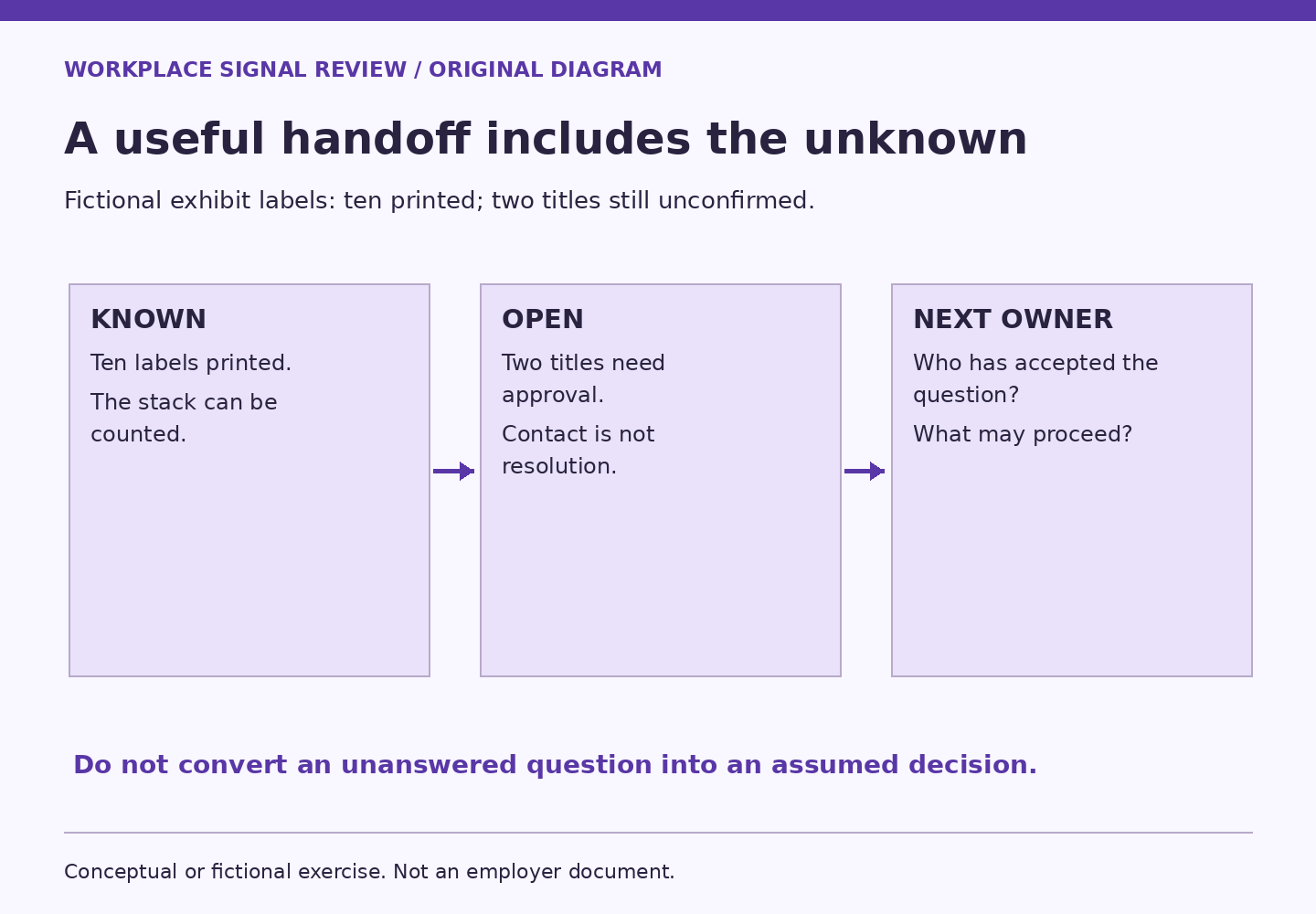
Separate three kinds of information
Fictional example: An exhibition volunteer passes a stack of blank display labels to another volunteer. Ten labels have been printed. The title on two labels is still unconfirmed. The organizer has been asked to check it, but has not replied. These are three different statements: a completed action, an unresolved issue and an attempted follow-up.
If the handoff says only “Labels printed; organizer contacted,” the receiver may interpret contacting as resolution. A clearer version is: “Ten labels printed. Two titles remain unconfirmed. The organizer has the question; no answer yet. Keep those two labels out of the ready stack until the authorized wording is confirmed.” The final instruction is valid only within our fictional exercise’s agreed process.
Say what the evidence supports
A fact might be directly observable: the printed stack contains ten cards. An interpretation might be “the two titles probably use the older wording.” A question might be “which title is approved?” Marking those categories helps the receiver avoid treating a plausible explanation as settled knowledge.
This is not an invitation to create private records of coworkers or copy internal messages. Use only approved channels and information needed for the real task. For this reading exercise, invented objects and invented decisions are enough. No personnel, customer or operational records belong in the publication’s tools or editorial email.
Confirm who owns the open question
A handoff should not quietly create an owner. “Someone should check” identifies a need but leaves responsibility unresolved. “Could you take responsibility for obtaining the approved wording?” asks for acceptance. If the receiver cannot do that, the team still needs a decision about who can. Sending a note is not the same as securing acceptance.
AHRQ’s handoff guidance discusses responsibility, uncertainty and questions in transitions of patient care. Our original label example borrows those broad communication concerns, not its clinical procedures or legal responsibilities. It does not establish an official Starbucks handoff format.
Preserve the limit on the next action
The receiver may need a boundary such as “do not print the final version until the title is confirmed.” That differs from a proposed solution such as “use the older title.” A boundary protects the unresolved decision; a proposal supplies one. Confusing the two can make an uncertain handoff look much more complete than it is.
In real work, mandatory checks and safety instructions come from the authorized workplace process. Never use this example to postpone an urgent report or replace a required procedure. If an issue cannot safely wait for an ordinary transition, the appropriate route is immediate official escalation.
Test the handoff by asking one question
Can the receiver say, in their own words, what is ready, what is still unknown and which next action they have actually accepted? If not, the missing information belongs in the handoff. A longer checklist is not automatically better; the objective is a shared picture of the present state.
Source boundary: AHRQ public page last reviewed May 2023 and checked October 8, 2026. All exhibition details are fictional. Continue with confirmation versus completion or the difference between a role and decision authority.