In this article
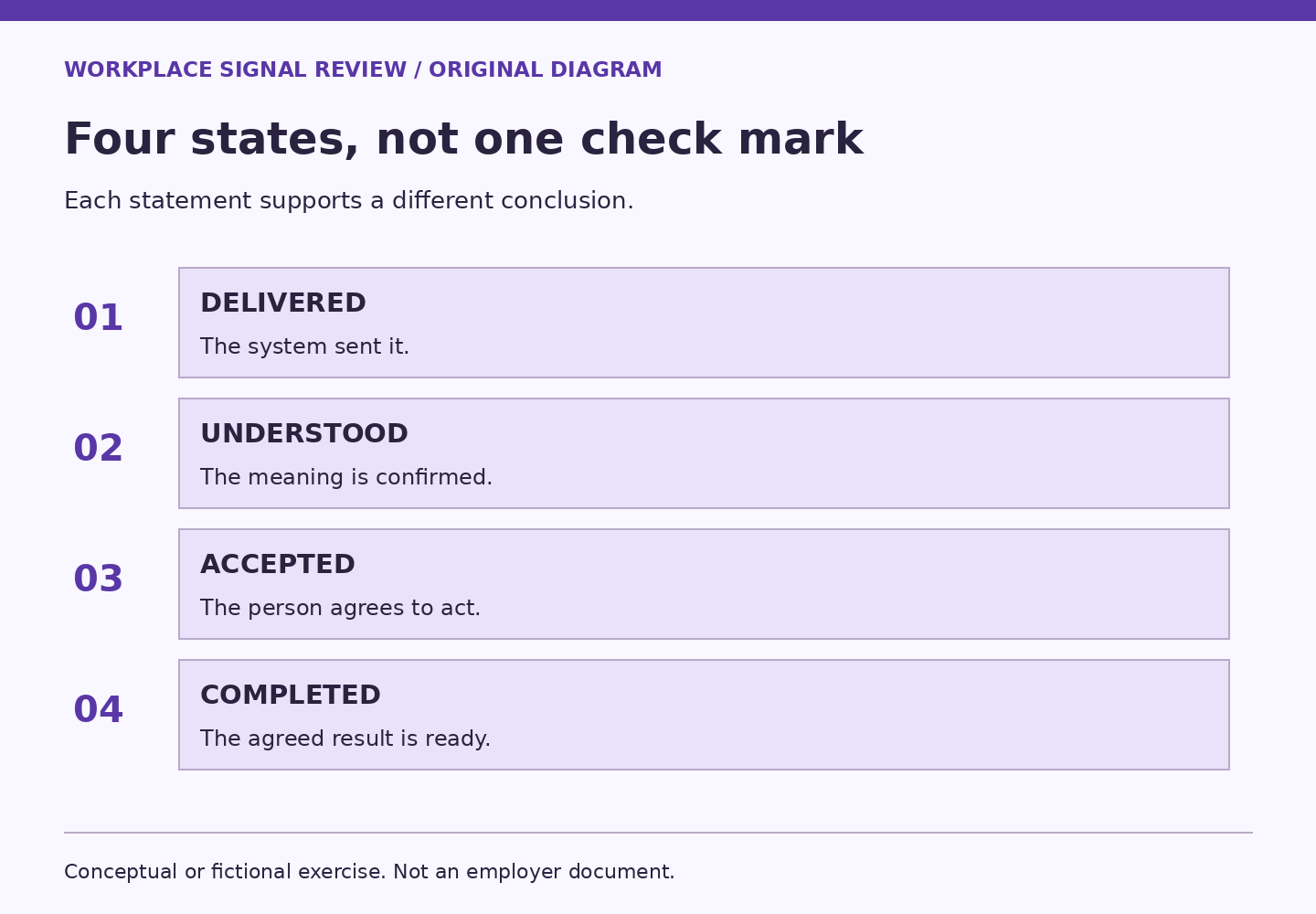
A delivery mark tells you something about a communication system. It does not necessarily tell you what another person understood, whether they accepted a request or whether the work is finished. Treating all four states as the same can create a confident but inaccurate picture of a team’s next step.
What “got it” leaves unresolved
Fictional example: Two volunteers prepare printed cards for a make-believe exhibition. One asks for twelve large cards. The other replies, “Got it.” Later, twelve small cards appear. The reply may have meant “I saw your note,” while the sender heard “I understood and accepted the size requirement.” There is no need to invent carelessness or bad intent to explain the mismatch.
A more informative exchange is: “I’ll prepare twelve large cards, using the large-card layout. Is that what you mean?” The sender can confirm or correct the interpretation before preparation starts. This is longer than a read receipt but shorter than repeating the entire job afterward.
Borrow the distinction, respect the source’s setting
AHRQ’s check-back resource describes a healthcare communication method in which the recipient acknowledges information and the source confirms that it was understood correctly. Its clinical purpose is important. This article uses only that general communication distinction in an original nonclinical example. It is not a clinical guide or evidence that Starbucks uses TeamSTEPPS.
The useful move is to reflect the meaning that could be misunderstood. In the card example, quantity and size are the risky details. Repeating a greeting, copying the whole thread or replying with a second emoji would add activity without testing those details.
Understanding still differs from agreement
A person can understand a request and be unable to accept it. “I understand you need twelve large cards; I can prepare eight with the materials available” is valuable information. It opens a decision about scope or alternatives. Reading that reply as agreement would erase the very constraint it communicated.
Likewise, agreement is not a completion report. “I will prepare them” is future intent. “The twelve large cards are ready at the agreed pickup point” reports a finished state. If an additional approval or inspection is required, completion wording should not conceal it. The actual workplace defines those requirements; our example cannot supply them.
Choose confirmation in proportion to the uncertainty
Not every casual update needs a formal three-part exchange. The editorial test is whether a mistaken interpretation would meaningfully change what happens next. A choice between two exhibition layouts deserves a clear confirmation. An optional reading recommendation may not. Do not impose a new reporting burden simply because a communication method exists.
If no acknowledgement comes, do not assume refusal, acceptance or absence. The appropriate next step depends on the approved communication channel, urgency and availability expectations. An urgent safety matter belongs in the established safety or emergency route, rather than waiting for an ordinary message to become marked as read.
End with a shared state
For practice, write four separate labels on scrap paper: delivered, understood, accepted, completed. Place each fictional reply under the state it actually supports. “Seen” supports less than “I can prepare those twelve large cards by the agreed time.” Neither proves they are already finished. That simple separation can prevent a great deal of invented certainty.
Source scope: AHRQ page last reviewed July 2023; public text checked October 8, 2026. The card scenario and four-state exercise are original. For transitions between people, see the open question in a handoff.