In this article
“A workplace problem” is a broad description. Public agencies have more specific responsibilities, and the right information route depends on what happened, where it happened and who is covered. This overview helps identify a question to ask. It cannot determine whether a law was violated, calculate a deadline or choose a legal strategy for an individual.
Separate the subject from the conclusion
Fictional example: A worker says a meeting was “unfair.” That word might refer to an ordinary disagreement, a safety concern, a pay issue, discrimination or treatment connected with group action. The label alone does not identify the relevant law. Begin with the subject and facts rather than assuming one agency handles every kind of unfairness.
For a real issue, do not post personal details publicly to crowdsource the classification. Use the appropriate official intake or qualified adviser. If there is an emergency or immediate danger, use the relevant emergency or safety route promptly instead of working through this reading exercise.
Recognize the broad U.S. federal subjects
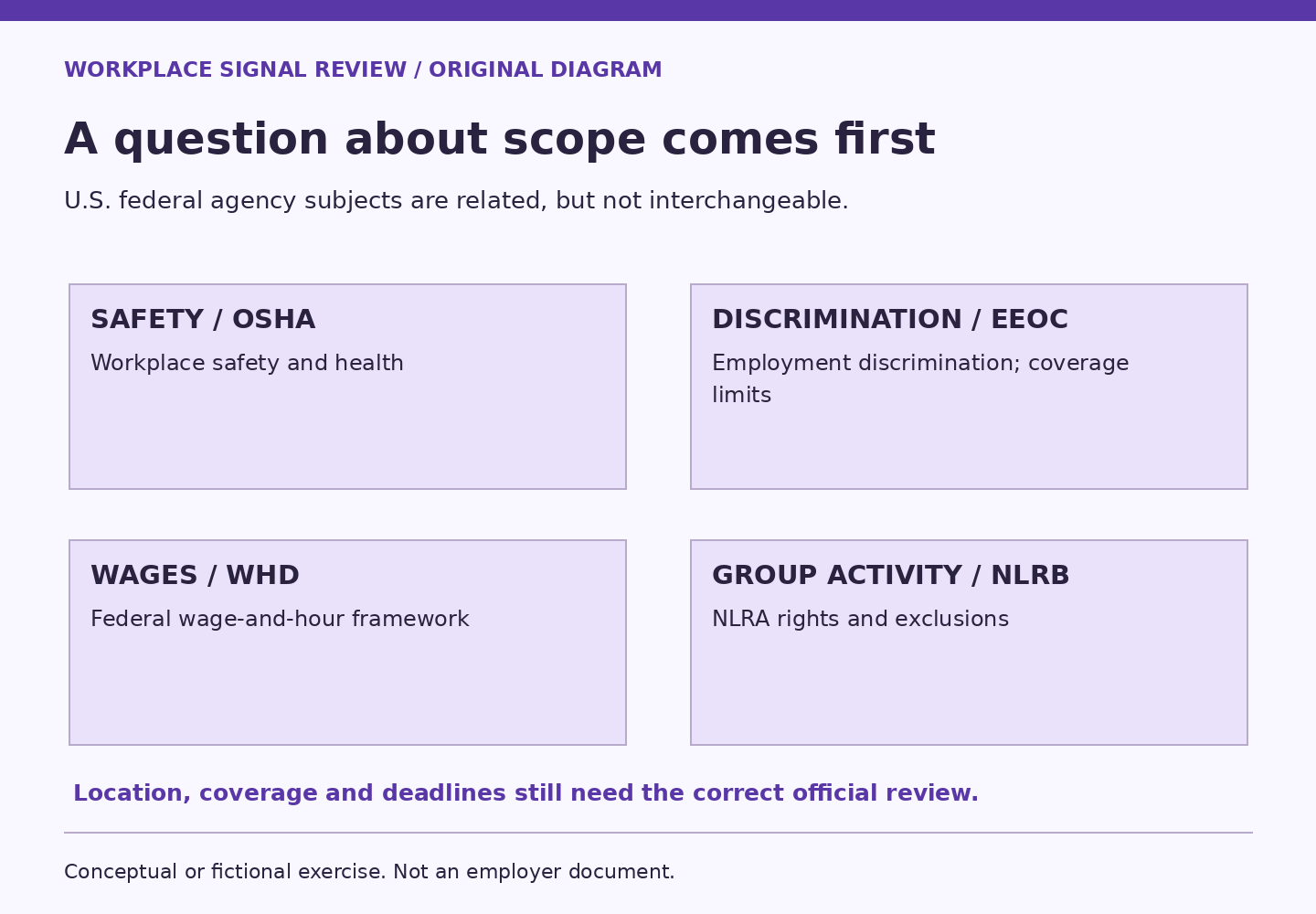
OSHA’s worker-rights page concerns workplace safety and health. The Department of Labor Wage and Hour Division’s recordkeeping information sits in a federal wage-and-hour framework. These subjects can overlap in a person’s experience while still raising different questions.
The EEOC overview concerns federal employment-discrimination protections, with coverage limits. The NLRB overview describes rights related to collective workplace activity under the NLRA, including activity without a union, and identifies excluded categories. Neither source means every employee or every action is covered.
Jurisdiction is part of the question
These are U.S. federal sources. State and local rules or agencies may also apply. A person working in another country needs that jurisdiction’s official information. Even within the United States, employer type, location and the nature of the concern can affect the available route.
The practical question is not “Which agency will agree with me?” It is “Does your agency cover this subject and these circumstances, and where should I obtain the correct information if it does not?” That wording allows the agency to explain scope without asking an unofficial publisher to decide a case.
Do not assume an internal process stops the clock
The EEOC’s deadline guidance says that attempting resolution through an internal grievance or another forum generally does not extend EEOC charge-filing limits. This matters even when an internal conversation is continuing. Different claims and processes can have different time rules.
Rather than relying on a simplified number from an article, contact the relevant official agency or a qualified adviser promptly when timing may matter. This publication provides no deadline calculator. A source-check date tells you when a public page was reviewed; it does not pause, extend or confirm your filing period.
Prepare a narrow scope question
For a fictional practice exercise, write the subject, country or state, type of employer and the date uncertainty. Leave names and identifying details out. In a real intake, the agency may need more information through its official process, but the publication does not receive or store that information on your behalf.
An internal channel and a public agency can serve different purposes. Reading about one should not be framed as a requirement to abandon the other, and this article does not require private confrontation before an official report. It simply encourages early, accurate scope and timing questions.
Evidence note: Public OSHA, EEOC and NLRB pages checked October 8, 2026. DOL’s official indexed recordkeeping text was reviewed that day; direct retrieval returned 403. The overview is educational, not individualized legal advice.