In this article
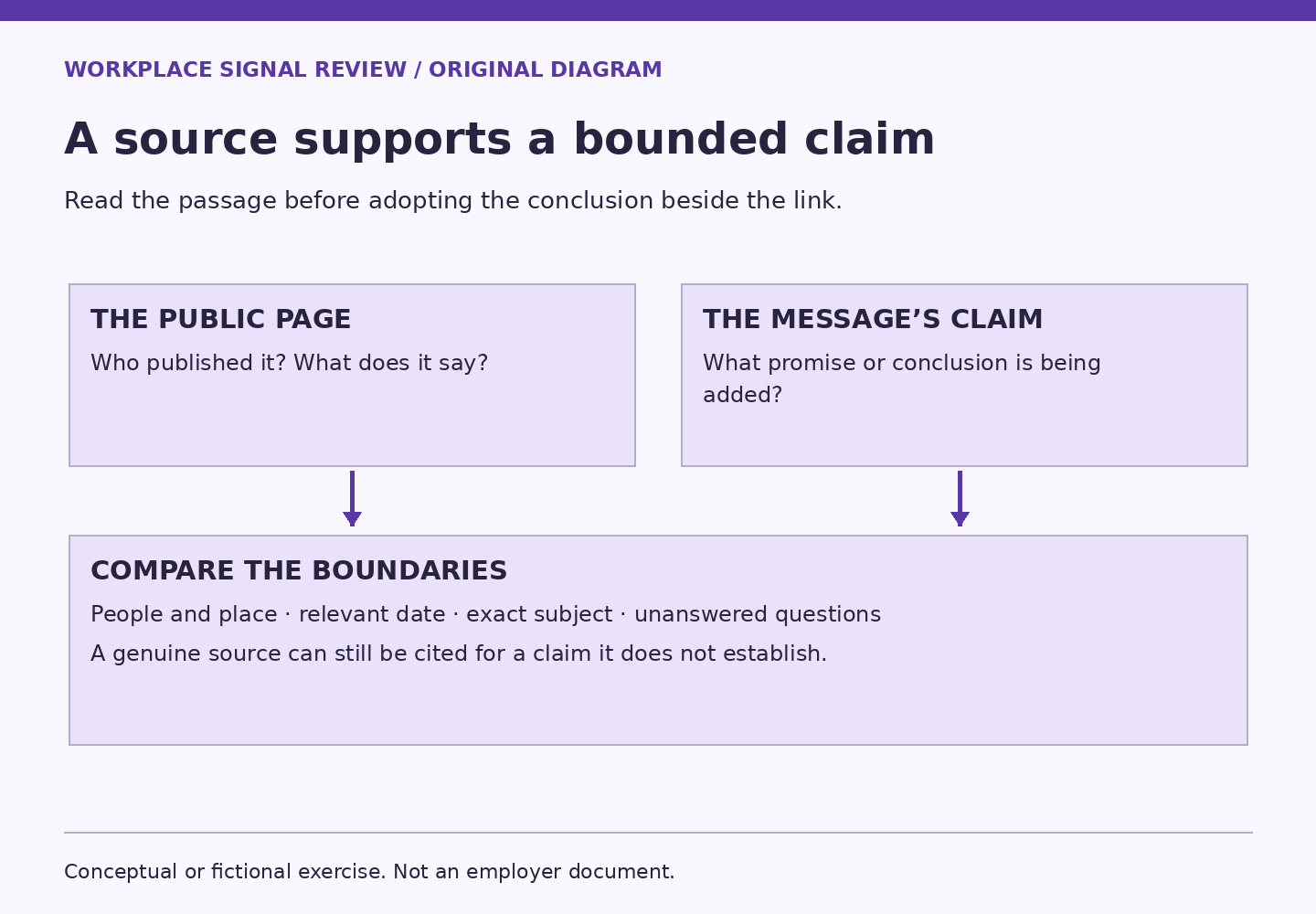
A link to an official website is useful evidence of where to look. It does not automatically support every claim attached to it. Someone can cite a genuine public page and still overstate what it says. The reading task is to match a particular sentence to the evidence that actually supports it.
Begin with the exact claim
Fictional example: A message says, “The company guarantees that every workplace concern is resolved in two days,” followed by a link to an ethics page. Before accepting or forwarding it, separate the claimed guarantee, the claimed scope and the claimed time period. A page that merely describes reporting resources would not establish any of those promises.
This example is invented. It is not an allegation about a Starbucks message or policy. The point is that a broad link and a precise promise are different kinds of evidence. The more specific the claim, the more specifically its source must support it.
Use an actual public page with a narrow reading
The Starbucks Ethics & Compliance page describes its program, encourages speaking up and links public business-conduct resources. Those are company statements about the program. This publication did not inspect a private report, test a reporting channel or independently evaluate how any case was handled.
The page’s existence therefore supports a limited sentence: Starbucks publishes an ethics-program page and related resources. It does not, on its own, establish a response deadline, prove a particular employee’s eligibility for a process or settle whether a specific incident was handled appropriately. Those missing conclusions should remain missing.
Preserve the source’s voice
“The company says” and “an independent investigation found” signal different evidence. A company statement is a primary source for the company’s stated position, but it is not independent verification of every outcome it describes. A reader can value the source while preserving that distinction.
Similarly, a worker’s account can be evidence of that person’s reported experience without establishing a universal rule. This publication does not fabricate employee testimony or present fictional dialogue as a real interview. Our made-up examples are labeled because their role is to explain reasoning, not to supply evidence about workplace conditions.
Ask four source questions
Who published the page? What does it actually say? Which people, places and period does it cover? What further conclusion is the message asking you to infer? Write brief answers before forwarding a consequential claim. If the scope is unclear, describe it as unclear instead of substituting the most convenient interpretation.
A screenshot can help someone locate a passage, but it may omit a date, qualification or later correction. Prefer the original public page for ordinary reading. Do not copy internal documents or personal records into this website’s search or tools to obtain an interpretation.
Know when verification changes the next step
If the claim affects an urgent concern, a legal deadline or a safety decision, a source-reading exercise is not enough. Use the relevant official route or qualified adviser promptly. If the issue is a low-stakes editorial correction, identify the public passage and the unsupported inference, then ask for the wording to be narrowed.
Evidence boundary: Starbucks public ethics page checked October 8, 2026. Linked private reporting systems were not entered, and linked PDF contents are not represented as reviewed. Continue with reading policy dates to avoid turning an old announcement into a present-day instruction.