In this article
A pay question often begins with an amount, but the first useful clarification may be a date. The period in which work occurred, the period grouped for payment and the day payment was issued are not interchangeable labels. Reading them carefully helps someone ask a more precise question without trying to diagnose a legal or payroll issue from one number.
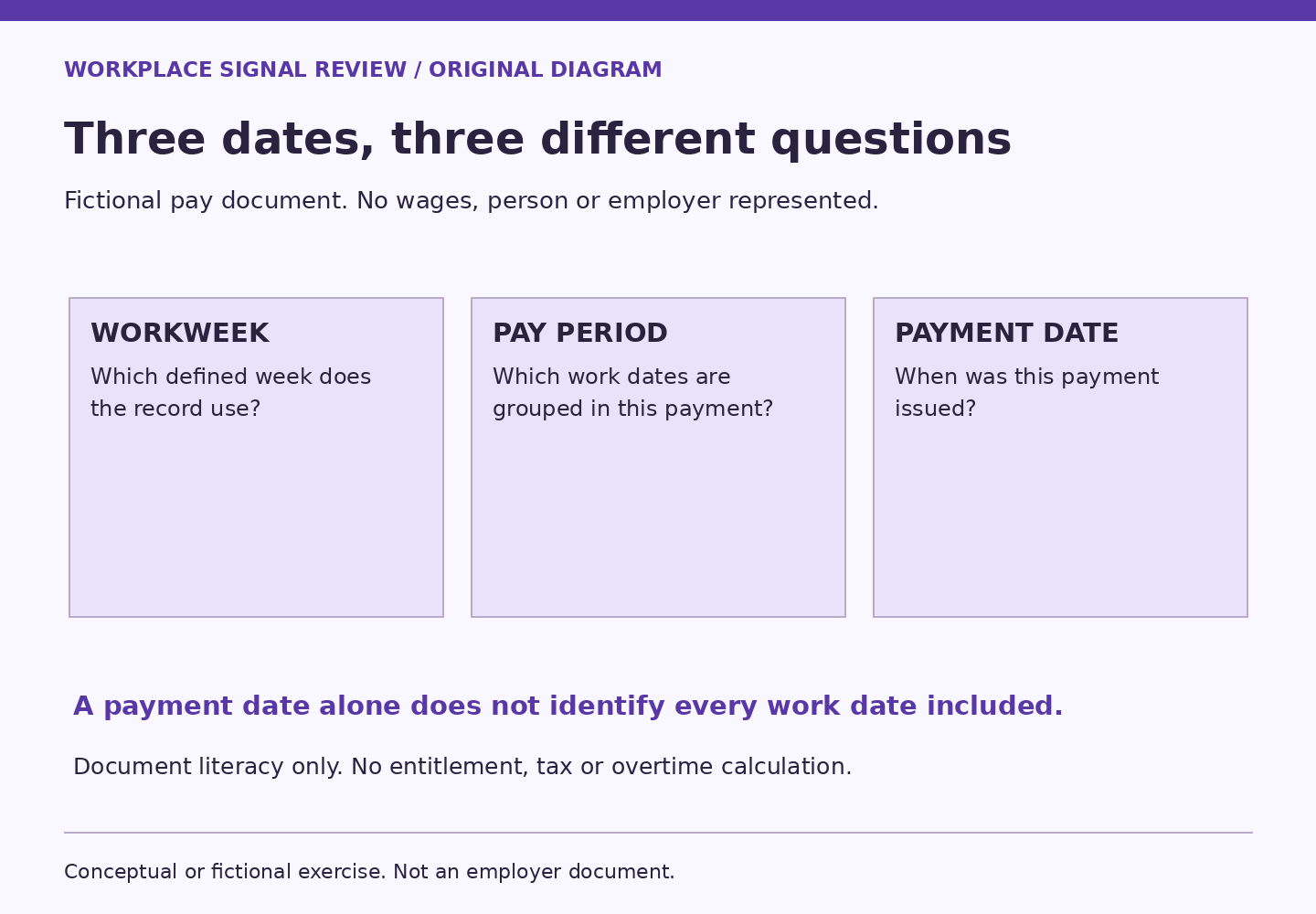
Use a document with no real person attached
Fictional example: A sample document says “period: September 1–14” and “payment date: September 20.” A separate fictional workweek begins each Monday. A reader asks whether work performed on September 18 is included in that payment. The answer cannot be inferred from the payment date alone; the stated pay period is the relevant starting point.
These dates are invented for document literacy. They do not describe Starbucks payroll, a legal pay frequency or an acceptable payment delay. The exercise deliberately contains no wage rate, deduction or employee identity. It cannot establish what an actual employer owes.
Understand why the labels are separate
The U.S. Department of Labor’s FLSA recordkeeping fact sheet lists workweek information, hours, wages, pay periods and payment dates among employer record fields for covered nonexempt workers. The existence of separate fields is a useful reminder that one date cannot stand in for another.
The fact sheet concerns employer records. It is not a claim that every worker-facing pay statement must have an identical layout. State or local requirements, coverage, exemptions and individual circumstances may matter. This article does not calculate overtime, deductions, taxes, benefits or legal deadlines.
Ask which record the question concerns
“My September pay looks wrong” may refer to a payment received in September, work done in September or a period crossing two months. A more useful question identifies the document’s stated period and the particular line requiring explanation. For example: “Which work dates are included in the period labeled September 1–14?”
Use the employer’s verified payroll or employment channel for an actual record question. Share only the information that channel needs and use its approved secure method. Do not send statements, banking details, tax identifiers or employee numbers to this publication. Our contact address is for editorial corrections.
Do not fill a gap with arithmetic
If a document lists a payment total without the relevant period, dividing by a guessed number of hours creates a guess, not an explanation. If a line has an unfamiliar code, its definition matters before comparing it with another line. A change in the displayed amount can have more than one possible explanation.
Similarly, matching two totals does not prove that every underlying entry is correct. Document reading helps formulate the next question; it does not replace an authorized record review. Preserve any real records through appropriate lawful means, and seek official assistance promptly when rights or payment are at issue.
A focused question is a useful outcome
In the fictional exercise, the reader’s next question is simply whether the September 18 work belongs to a later pay period. It is not “Why did the employer withhold my money?” The latter adds a conclusion not established by the sample. Precise language leaves room for a factual answer while preserving the ability to raise a substantive concern if evidence supports it.
Source-access note: The official indexed text of DOL Fact Sheet #21, marked revised July 2008, was reviewed October 8, 2026. Direct page retrieval returned HTTP 403, so this is not a claim of live-page verification or a new 2026 rule. For real U.S. rights questions, consult current official guidance or a qualified adviser.