In this article
A date next to a policy story can answer several different questions, and readers often assume it answers all of them. When was the story published? When was a change announced to begin? When did someone last check the source? Does the rule still apply to this location today? Those dates and questions should remain separate.
Read a real announcement as a historical source
Starbucks published a dress-code announcement on April 14, 2025. The public text described a May 12 start and framed the change around its North America coffeehouse context. That supports a statement about what the company announced in 2025.
This article does not reproduce the clothing rules as current instructions. Checking that the announcement remains publicly readable in October 2026 does not establish that every detail is still current or applies to a particular worker. A historical public page and the applicable current workplace instruction have different jobs.
Build a four-date reading habit
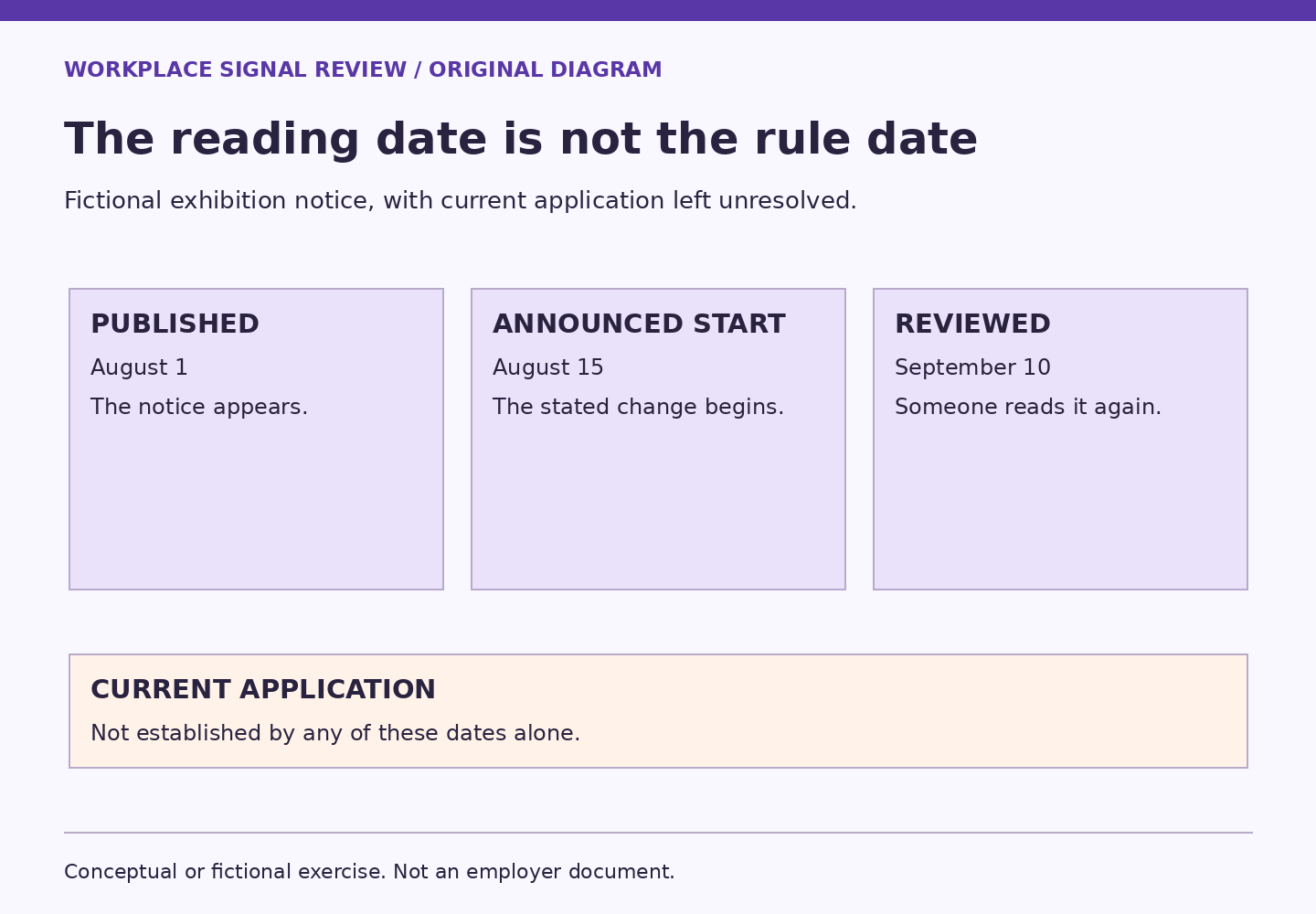
Fictional example: An exhibition notice was posted August 1, says a new entrance arrangement starts August 15 and is read again September 10. A reader writes “new rule from September 10.” That turns their reading date into an effective date. The error arises even if they copied the rest of the notice accurately.
Record publication date, stated start date and your review date separately. Then add a fourth field: current application verified or not verified. Sometimes the source gives no clear start date. Sometimes it names an event date but no policy change. An empty field is more accurate than a date borrowed from the footer.
Scope travels with the date
A change may concern one country, one type of location, a particular role or a defined period. Removing that scope can turn a narrow statement into a universal claim. In the fictional exhibition, a notice for the east entrance does not establish the arrangement for every entrance.
Be equally careful with phrases such as “all stores” inside a paragraph that already defines a region. The broader sentence should be read in its context, not isolated as a global promise. When applicability is unclear, ask the relevant authorized owner rather than inferring it from familiarity with the brand.
What a source-check date actually promises
This publication labels the date on which public evidence was reviewed. That is useful editorial information, but it is not certification of an internal policy or a guarantee that the source will never change. The review can support a description of the page at that time; it cannot prove every real-world implementation.
A later correction should explain what changed, which claim it affects and whether the earlier wording was inaccurate or simply became outdated. Quietly replacing a source date without checking the underlying claim would create a misleading impression of freshness.
Repeat only what you can support
A careful summary might say, “The company announced this change in April 2025, with a stated May start; check the current applicable instructions.” A careless one says, “This is definitely the rule everywhere now.” The first preserves useful history. The second adds current and universal conclusions the historical page does not establish.
For a real workplace action, use the verified current source supplied through the appropriate employer process. This publication cannot approve exceptions or interpret a private instruction for an individual. It can help you notice which date and scope questions are still unanswered.
Source note: Starbucks announcement dated April 14, 2025; public text checked October 8, 2026. The exhibition timeline is fictional. For the wider evidence question, see Trace the Claim, Not Just the Link.