In this article
A message can be perfectly readable and still leave its reader guessing. “The display needs checking” could report a condition, request a volunteer or direct a particular person to act. Those are different communication jobs. The first useful question is not whether the sentence sounds friendly. It is what response the sender actually needs.
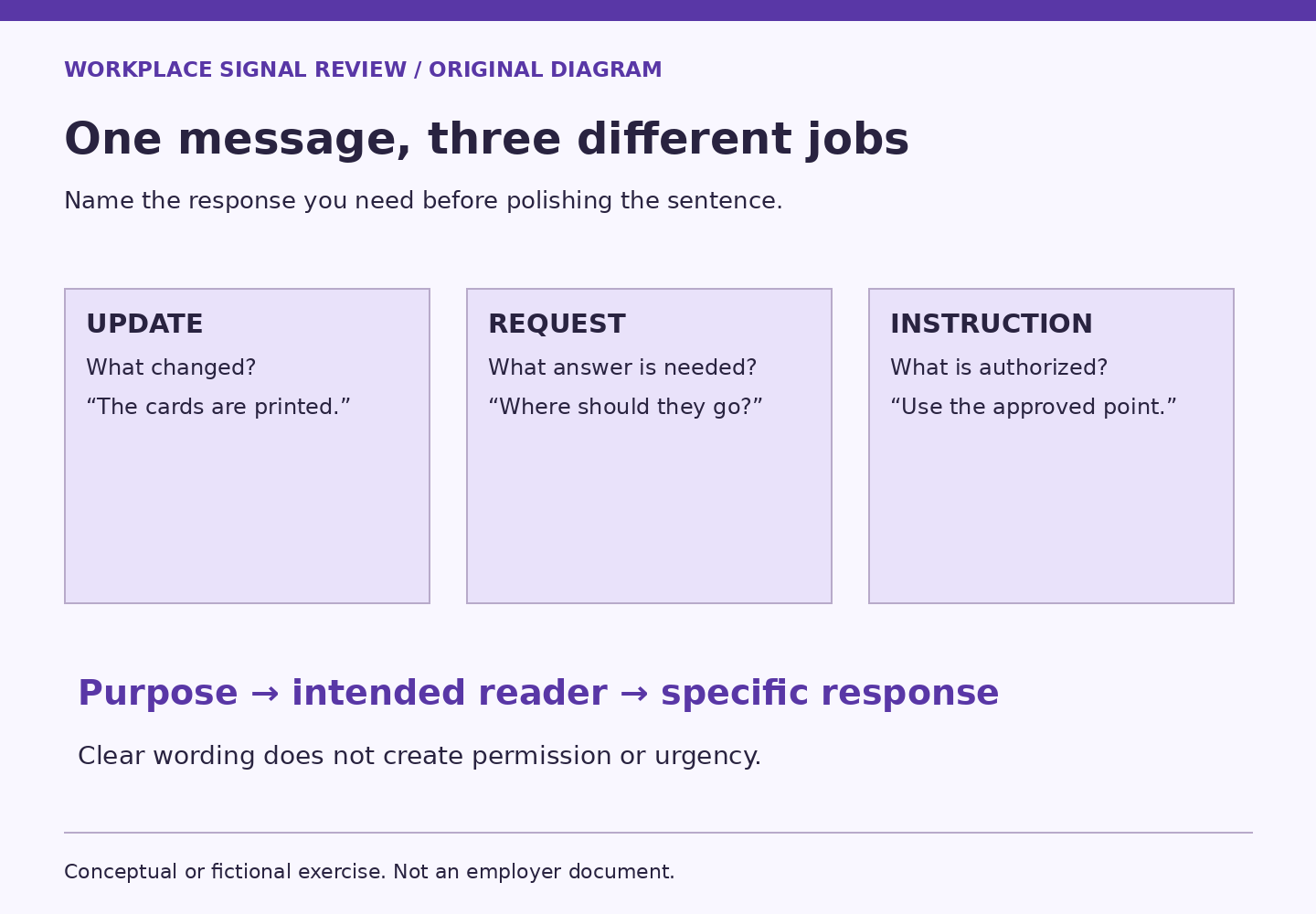
Three readings of one sentence
Fictional example: An imaginary community exhibition uses cardboard signs. A note says, “The blue signs are ready.” The print volunteer means they are available for collection. The exhibit organizer interprets it as confirmation that the signs have been installed. A third reader thinks no action remains. All three understand the words; they disagree about the state of the work.
Try naming the message’s purpose before adding more detail. An update tells the reader what changed. A request asks someone to do or decide something. An instruction sets out an authorized requirement. A sentence can combine these, but the connection should be visible. “The blue signs are printed. Could the exhibit organizer confirm where they should be delivered?” separates the new fact from the open decision.
Identify the actor without pretending to assign authority
The GSA’s writing guidance explains that active voice can clarify who performs an action. It is a general writing principle, not permission to direct a coworker. In our exercise, naming “the exhibit organizer” identifies the needed decision-maker. It does not establish that the sender may command that person or change the event plan.
This distinction matters when editing your own draft. Replacing “Someone must approve this” with “You must approve this” is clearer only if “you” really holds that responsibility. When authority is unknown, an honest question is better: “Who can confirm the approved delivery point?” The missing fact belongs in the conversation rather than being silently filled in.
Make the requested response observable
“Please handle this” leaves the endpoint open. Does handling mean reading, deciding, moving an item or confirming completion? Our fictional note could ask for one of three specific responses: confirm the pickup location, collect the signs, or say whether a different arrangement is needed. Choose the one that addresses the actual uncertainty.
Do not attach a deadline merely to make a request look complete. A useful time reference explains a dependency: “We need the delivery point before packaging the signs at 2 p.m.” That example is invented. In real work, response expectations and working-time boundaries depend on the applicable arrangement; receiving a message does not by itself settle them.
Use labels as an aid, not a hierarchy of importance
A subject such as “Decision needed: delivery point” helps a reader understand the job. “Update: signs printed” does something different. Neither label guarantees urgency or priority. An update about a hazard may require immediate action through the proper safety route, while a request about a future optional event may wait.
Finish the exercise by reading the note from the recipient’s position. Can they tell what is known, what remains open, whether they are the intended reader and what kind of reply would help? If one answer is missing, add that piece. Avoid turning a two-sentence request into a history of every earlier conversation.
A small editing test
On this publication’s Signal Card Lab, compare a fictional request with and without purpose, ownership and confirmation. There is no universal perfect message and no worker score. The point is to notice what the wording makes possible. For a decision with more than one acceptable outcome, continue with asking for a decision.
Evidence boundary: Public GSA writing guidance checked October 8, 2026. The message categories, exhibition example and editing test are original editorial analysis, not Starbucks policies.